

Blueback herring are one of the keystone species in the Delaware Estuary. Photo courtesy of Lance Butler.
The Delaware Estuary Program’s Science and Technical Advisory Committee (STAC) recently published a white paper about the status of American shad and river herring in the Delaware River Watershed, revealing mixed news on how these fish are faring.
The report, “Life History, Population Status, and Restoration of American Shad and River Herring in the Delaware River Basin,” encapsulates the most recent information on American shad and river herring. It is the product of a year’s worth of collaboration among technical experts in the field of fish ecology that were convened as part of a STAC subcommittee. This report reviews six indices that reflect American shad and river herring population health, which are tracked by the Delaware River Basin Fish and Wildlife Management Cooperative.
“This report’s comprehensive review highlights the extensive efforts by member states to determine population dynamics of American shad and river herring in the Basin while providing guidance on actions needed to better understand threats and paths to restoration,” said Gregory Lech, co-author, STAC chair, and fisheries biologist with the Pennsylvania Fish and Boat Commission. “The report highlights the complexities associated with management of migratory fish in the historic Delaware River Basin and provides a comprehensive resource to stakeholders for future research.”
Sheila Eyler, lead author and biologist with the U.S. Fish and Wildlife Service, said that populations of American shad and river herring, once abundant in the Delaware River and Estuary, are depleted and that with reduced populations, the critical ecosystem services they provide may likewise become threatened. The paper seeks to fully assess the status of these fish in the Delaware River Basin while providing recommendations on how to best manage for the continuing health of their populations.
The fishery management agencies of the Delaware River Basin Fish and Wildlife Management Cooperative are tracking the population trends through time and working with partners to manage and restore stocks.
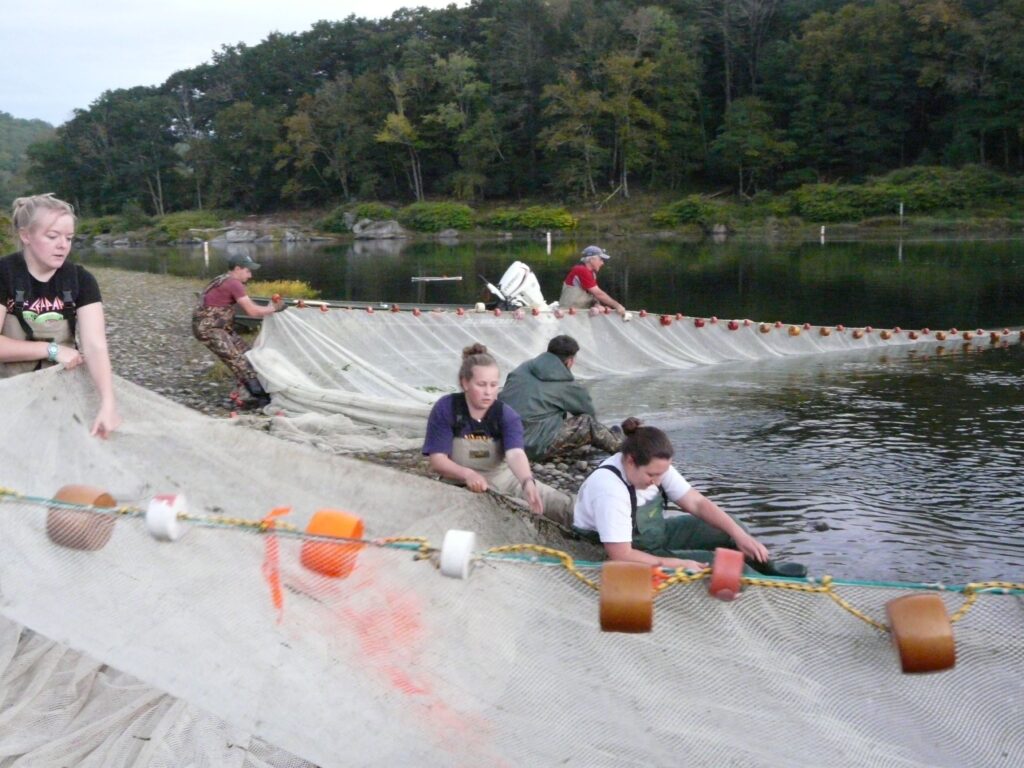
Representatives from the Philadelphia Water Department seine for shad in the upper Delaware River. Photo courtesy of the Philadelphia Water Department.
American shad, along with alewife and blueback herring (collectively termed river herring), are keystone fish species within the Delaware River Basin. All three species undertake seasonal migrations to spawn in Delaware River tributaries and provide numerous benefits to communities and habitats along the path of their journey.
“Historically, both indigenous people and early colonizers of the Delaware River Basin relied on the abundant American shad and river herring as vital food sources. However, their numbers have decreased to the point that we are looking to help preserve and restore these populations however we can,” said Ella Rothermel, co-author and urban resilience assistant manager at the Partnership for the Delaware Estuary. “Besides their cultural importance, American shad and river herring are also an important part of our local ecosystem as both predators and prey, helping with nutrient cycling, and acting as a host fish for our native freshwater mussel species.”
Overall, there is both good news and bad news to report on the status of these signature migratory fish species. On the positive side, water quality in the Delaware River Basin has improved, and efforts to remove the dams that impede fish passage have gained momentum. Lance Butler, co-author and senior scientist with the Philadelphia Water Department, said that with these positive restoration trends, “each step toward renewal carries the promise of revitalized rivers, enriched biodiversity, and the reconnection of communities with a heritage once defined by these iconic fish.”
However, populations of American shad and river herring remain at historic lows and threats such as predation and changing water conditions will continue to affect these species moving forward. “Changing environmental conditions is a challenge that we all must face, now and in the future,” said Ron Heun, co-author and environmental compliance and program manager at PSEG. “Continuing to conduct meaningful research within the Delaware Estuary is the best way to understand and combat changes in the aquatic ecosystem. PSEG recognizes these challenges and supports the Partnership for the Delaware Estuary and its goals to improve water quality and aquatic habitat restoration, as well as protecting and understanding our aquatic resources.”
This paper serves as a cornerstone to understanding the ecological dynamics of the watershed, said LeeAnn Haaf, Ph.D., estuary science director at Partnership for the Delaware Estuary and advisor to the STAC.
“The report offers critical, species-specific insights that will help inform and strengthen the comprehensive assessment of the Estuary and Basin’s overall health,” Haaf said.
The assessment Haaf mentioned, known as the Technical Report for the Estuary and Basin, has been completed every five years since 2012 and is forthcoming in 2027.
The primary role of the PDE’s Science, Technical and Advisory Committee is to offer objective, expert guidance and peer review on scientific and technical issues that support the goals of the Delaware Estuary Program and its partners. This includes advancing initiatives outlined in the Program’s Comprehensive Conservation and Management Plan (CCMP).
The 2025 Life History, Population Status, and Restoration of American Shad and River Herring in the Delaware River Basin Report can be found on the PDE website.
Visit the 2019 CCMP for the Delaware Estuary and the 2022 Technical Report for the Estuary and Basin for more information.
Additional questions can be directed to Haaf or Rothermel. Please visit the PDE website to learn more about the STAC.
