

Above: The dense green canopy of leaves from wild celery (Vallisneria americana) grows in an aquarium for study. In the wild, it provides shelter for fish and invertebrates, as well as food for waterfowl and small animals in the Delaware River and Estuary.
Dive Into the World of Wild Celery
By Jessica (Jecy) Klinkam, Community Ecology Research Fellow
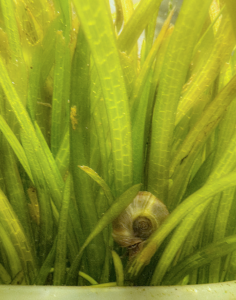
The Delaware Estuary is full of natural, hidden wonders. In just a little time spent along the rivers, you will often encounter waterfowl or a small mammal, such as a muskrat ambling through the underbrush. At the riverbank, you can see flitting fish, hidden freshwater mussels, or a snail the size of your fingernail. And as you keep looking, you’ll notice the green backdrop of submerged aquatic vegetation (SAV) that connects all of these organisms, from the ducks flying high above to those tiny snails. A dominant member of this underwater green community is Vallisneria americana, more
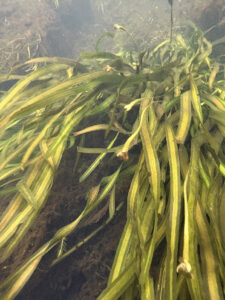
commonly known as wild celery.
Wild celery is a native plant that lives entirely underwater. Its dense canopy of leaves provides shelter for fish and invertebrates and food for waterfowl and small mammals. These underwater meadows support entire food webs, making them a foundation species in the Delaware Estuary. When SAV,
such as wild celery, declines, the effects ripple outward, resulting in less resilient ecosystems.
Wild celery’s long leaves help to improve water clarity by slowing water movement, which allows suspended sediment to settle. These leaves also improve water quality by producing oxygen and absorbing excess nutrients like nitrogen and phosphorous. The plant’s dense roots stabilize sediment, helping to reduce erosion. In the Delaware Estuary, with a long history of industrialization and urbanization, these ecosystem services are invaluable.
Scientists at PDE and partner organizations are working to protect, enhance, and restore wild celery in the Delaware River and beyond. For example, through funding from the National Fish and Wildlife Foundation, PDE has recently installed one of the first living shorelines in the Delaware River at the Camden County Municipal Utilities Authority’s Water Treatment Plant in Camden, New Jersey.
As part of the living shoreline design, PDE will plant native wild celery to enhance existing submerged aquatic vegetation meadows and further bolster the essential ecosystem services of submerged aquatic vegetation. By protecting foundational plant species, such as wild
celery, we can make a big difference in the health of the Delaware Estuary for all communities, human and non-human, that rely upon it.
