Science Fellows Share Their Experiences on the Job
Dirty Hands, Deep Purpose
By Sydney Gawason, PDE’s Coastal Restoration Fellow
I was never the type of kid to play in the dirt. I didn’t pick up bugs. I didn’t roll around in the grass. And then I changed.
After taking an environmental science course in high school, I became interested in the systems that shape the natural world. That led me to the University of Vermont, where my classroom became the mountains, the lake, and the forest.
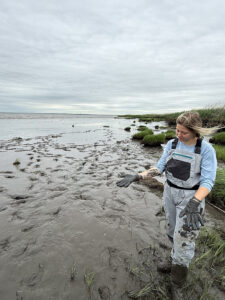
In the few months I’ve been a Coastal Restoration Fellow with Partnership for the Delaware Estuary (PDE), I’ve learned the importance of getting my hands dirty — literally and figuratively. I’ve lugged, tossed, and planted bags of recycled oyster shells for oyster studies and tagged mussel shells for later study in ponds. It’s messy work, but I look forward to
digging my hands into the silt of a saltmarsh and feeling it ooze between my fingers. Those shell bags will attract shellfish, stabilize shorelines, and filter water. Other days call for
digging in mentally — organizing data, mapping project sites, or attending workshops on nature-based solutions and aquatic vegetation identification.
Everyone at PDE is deeply engaged in both the community and the environment, and I see daily how much that impacts the Estuary. This fellowship has given me the chance to get outside, get my hands dirty, and learn alongside a team of dedicated scientists.
Protecting What I Love
By Kathryn Krueger, PDE’s Estuary Science Fellow
I trudge over sulfurous saltmarsh that sucks at the bottom of my feet. With each step, I feel at home. The ground beneath coarse cordgrass and saltmarsh hay is alive with fiddler
crabs. Above, the sky is full of diving saltmarsh sparrows, and it reminds me why I’m the Estuary Science Fellow for the Partnership for the Delaware Estuary (PDE) — to protect what I love by learning to conserve coastal environments and the wildlife they support.
Like many in this field, my love of nature began in childhood, exploring mid-Atlantic beaches, bays, and marshes.
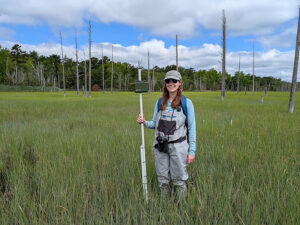
Later, while studying Ecology and Conservation at West Chester University, a class trip to Bombay Hook National Wildlife Refuge in Smyrna, Delaware, cemented my choice to protect coastal wetlands.
Coastal wetlands are among the most rapidly disappearing ecosystems worldwide. I’m working at PDE to help reverse that trend through restoration and conservation within the Delaware Estuary. One of the most important lessons I’ve learned here is that a healthy, resilient estuary fosters healthy, resilient communities. A healthy estuary provides clean water, abundant food, and protection from storms and flooding. Without any one of these provisions, communities are more susceptible to harm — poor water quality, unsustainable fisheries, and a lack of available food. Just as a healthy estuary supports our resilience, our choices shape its health. Education, stewardship, and activism help communities understand and prevent negative impacts, so people and the estuary can support one another.
By learning restoration and conservation practices, coupled with education and outreach, I hope to help build a healthier, more resilient Delaware Estuary — and stronger local communities.
Stay tuned. More stories from our interns and fellows are coming!
